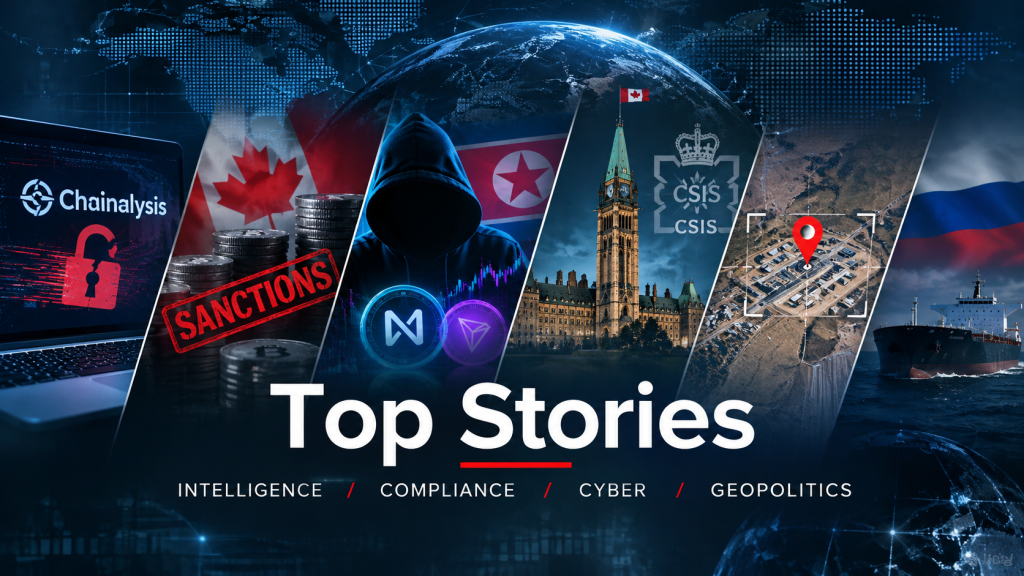
This week: a blockchain-intelligence vendor’s breach widened to every user account, Treasury sanctioned eight Canadian money services businesses, and Ottawa signalled a bigger foreign-intelligence role for CSIS.
Top stories
1. Chainalysis breach reaches every user account; services restored in stages
Chainalysis confirmed that names, usernames, password hashes and live tokens for all users were exposed, after first reporting only a subset of passwords. It took Reactor, KYT, Address Screening and Data Solutions offline, then restored KYT and Address Screening from Nov 6, Reactor on Nov 7 and Data Solutions on Nov 10. Returning customers must allowlist trusted IPs, reset passwords and rotate API keys. The company says it has no evidence investigations data was accessed or attribution data altered, and the attacker is unnamed.
Why it matters: If your compliance or investigations team uses Chainalysis, confirm keys were rotated and check whether any KYT screening gaps during the outage need to be re-run.
2. U.S. Treasury sanctions eight Canadian money services businesses over Iran
On Nov 6, OFAC designated eight Ontario- and B.C.-based MSBs, saying they converted Iranian rials into digital assets and transacted with sanctioned Iranian exchanges and IRGC-linked addresses. OFAC published six TRON addresses tied to four of the firms. FINTRAC said the same day it coordinated with OFAC and FinCEN, has revoked 161 MSB registrations since January, and imposed more than $198 million in penalties on nine MSBs over the past year.
Why it matters: Canadian reporting entities should screen counterparties and wallets against the new designations now, not at the next list refresh.
3. Binance theft launderers mint throwaway memecoins on NEAR and Tron
Elliptic reported on Nov 9 that launderers of the $6.4 billion Binance theft, which the FBI attributes to North Korea’s TraderTraitor, created six worthless tokens on NEAR between Nov 5 and 7, at about $90 each. Stolen funds bought in through one set of wallets and were sold out through another, with a liquidity pool in between, moving about 117,000 NEAR (roughly $430,000). Every token went quiet after Nov 8. Elliptic says the method slows investigators down rather than hiding funds.
Why it matters: Funds arriving from a DEX liquidity pool are not clean by default; tokens traded only by a tight wallet cluster are a red flag worth a rule.
4. Ottawa signals a foreign-intelligence mandate for CSIS
Following the federal budget, which commits about $6 billion to CSIS over 10 years, Privy Council Office official Dominic Rochon said the government wants CSIS to collect more intelligence abroad and is open to a separate human foreign-intelligence agency later. He said legislative change will be needed; no bill or timeline has been named. CSIS is currently limited mainly to threats within Canada.
Why it matters: A broader CSIS mandate would change how Canada sources foreign intelligence, including its reliance on allies and on open sources.
5. Online map labels expose sensitive sites on U.S. bases
Bellingcat researcher Sebastian Vandermeersch found Google Maps labels, photos and reviews identifying headquarters, sleeping quarters and senior officers’ offices on U.S. bases in Jordan, Kuwait and Qatar, some of which Iran has struck. Reviews also revealed busy hours at facilities. Bing said it blurs or removes details at government request; Google and the U.S. military did not respond.
Why it matters: The same exposure applies to any facility: audit what staff and visitors have posted on map platforms about your own sites.
6. Russia threatens retaliation as Western shadow-fleet seizures continue
On Nov 10, Foreign Minister Sergei Lavrov called Western detentions of shadow-fleet vessels “piracy” and promised a “mirror and asymmetric response.” France has detained six such tankers in the past year, most recently the DF Peak in the Indian Ocean, and a Swedish court upheld the arrest of the cargo ship Caffa.
Why it matters: AIS alone is not proof of location; vessel due diligence should pair it with satellite imagery and ownership history.
Threat landscape quick hits
- CISA KEV, Nov 10: six actively exploited flaws added. Barracuda CVE-2026-116606 (Email Security Gateway, CVSS v4 9.3) and CVE-2026-111560 (CVSS 8.6) carry a Nov 13 federal deadline; the other four are due Nov 24.
- CVE-2026-124194, Microsoft Outlook (CVSS 6.5): exploited spoofing flaw, fixed in November Patch Tuesday. A crafted message file makes Outlook connect to an attacker host without the external-content warning, leaking NTLMv2 hashes. No IOCs published.
- CVE-2026-20320, Cisco BroadWorks (CVSS 7.5): unauthenticated XXE in the OCI XML parser, patched in August. Malbear Labs tied exploitation to “Operation Snowball,” an agentic campaign against a European telecom and 13 hosted companies, with subscriber billing and device records exfiltrated over about two weeks.
- CVE-2026-125350, Google Chrome (CVSS 8.8): on KEV as of Nov 10; update browsers fleet-wide.
- CVE-2026-111793, Openwave Messaging Webtop (CVSS 4.3): low score, but exploitation confirmed by the developer via JVN.
- Cyber Centre (CCCS): advisories this week for SonicWall (AV26-1133), Barracuda (AV26-1112, updated Nov 9), Red Hat, IBM, Dell, OpenBSD and SAP’s November rollup (AV26-1137). No new AL-series alerts.
Tools & resources
- OFAC TRON addresses (Nov 6): six addresses tied to four of the sanctioned Canadian MSBs, listed in the designation; load them into wallet screening. TRM’s write-up maps the flows between designees.
- OpenOSINT: MIT-licensed agent with 21 passive-by-default modules (email, username, WHOIS/RDAP, DNS, subdomains, Shodan, Censys and more), usable as a CLI, web UI or MCP server.
- novaya-gazeta-ru/archive: downloads Novaya Gazeta articles as Markdown with images, useful for preserving Russian-language sources.
- Papra: minimal self-hosted document archive for case files.
- OSINT Repos Intelligence Dataset, Nov 8 update: OSINTech’s tracked set now covers 4,471 repositories (full list for paid subscribers).
On the calendar
- Nov 13: CISA deadline for the two Barracuda KEV entries; Nov 24 for the other four.
- Nov 16–20, Toronto: Bellingcat five-day in-person deep-dive workshop (EUR 3,200; applications manually approved).
- Nov 17–19, Izmir: NCIA briefs its draft OSINT capability problem statement at NATO Edge 26. The planned platform covers about 820 analysts; invitation for bids expected Q1 2027, open to NATO-nation firms only.
- Feb 1–2, 2027, Alexandria, VA: SANS OSINT Summit, with SEC587 and SEC497 training Feb 3–8 (in person or live online).
Sources
- Chainalysis: Security incident information (updated Nov 10)
- The Hacker News: Chainalysis breach exposes all users’ credentials
- Tech Insider: Chainalysis breach widens
- FINTRAC statement, Nov 6, 2026
- TRM Labs: OFAC designates eight Canadian MSBs
- Elliptic: North Korea is minting meme coins to launder the Binance hack
- Elliptic: Binance, the largest hack in history
- National Post via Yahoo: Ottawa wants to expand spy agency’s powers
- The World: How Google Maps leaves US service members exposed
- Bellingcat: How online maps lay bare the US military bases targeted by Iran
- Ukrainska Pravda via Yahoo: Russia threatens West with vessel seizures
- SecurityOnline: CISA KEV adds six vulnerabilities
- SecurityOnline: Outlook zero-day CVE-2026-124194
- The Hacker News: Cisco BroadWorks and Openwave flaws actively exploited
- Canadian Centre for Cyber Security: Alerts and advisories
- GovCon Exec: NCIA invites feedback on OSINT capability
- OSINTech: OSINT Repos Intelligence Dataset update, Nov 8